

Note
Go to the end to download the full example code.
Long-Term Correction with MCP#
This example shows how to perform a Measure-Correlate-Predict (MCP)
long-term correction using LinRegMCP and
VarRatMCP.
The workflow is:
A long-term (LT) reference station provides many years of wind data.
Short-term (ST) target on-site measurements that overlap the reference data (concurrent period).
An MCP model is fitted on the concurrent period, mapping reference wind speeds to site wind speeds sector by sector.
The fitted model is applied to the full long-term reference to produce a long-term corrected site wind climate.
Generate Synthetic Data#
import numpy as np
import matplotlib.pyplot as plt
import pandas as pd
import windkit as wk
from windkit.ltc import LinRegMCP, VarRatMCP, calc_scores
from windkit.spatial import create_point

out_locs = create_point(500000, 6200000, 80, 32632)

period_lt = pd.date_range("2004-01-01", "2009-01-01", freq="1h", inclusive="left")
period_st = pd.date_range("2008-01-01", "2009-01-01", freq="1h", inclusive="left")

# Generation of synthetic data for a correlated pair, with same direction bias.
tgt_lt, ref_lt = wk.create_tswc_pair(
    out_locs,
    date_range=period_lt,
    weibull_A=(6.0, 8.0),
    weibull_k=(1.6, 2.2),
    target_r2=0.8,
    direction_bias=0,
    speed_tau=14400.0,  # set the e-folding timescale for the wind speed
)
ref_st, tgt_st = ref_lt.sel(time=period_st), tgt_lt.sel(time=period_st)
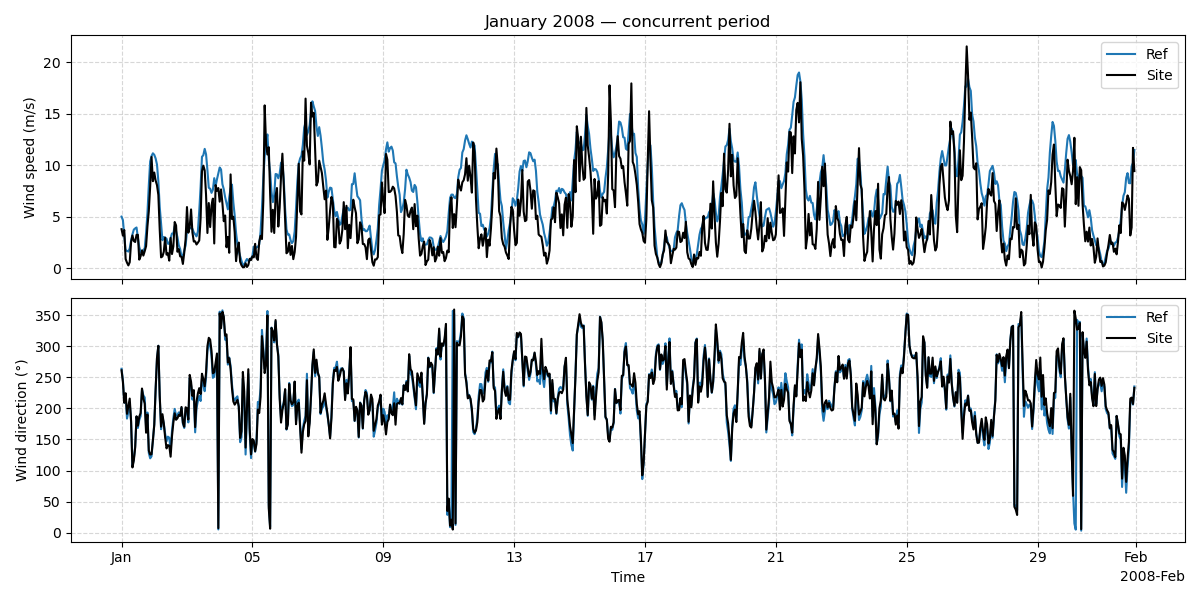
Concurrent Period Time Series#
fig, (ax_ws, ax_wd) = plt.subplots(2, 1, figsize=(12, 6), sharex=True)
for ds, color, label in [(ref_st, "C0", "Ref"), (tgt_st, "k", "Site")]:
    sl = ds.sel(time="2008-01")
    sl.wind_speed.plot.line(x="time", ax=ax_ws, color=color, label=label)
    sl.wind_direction.plot.line(x="time", ax=ax_wd, color=color, label=label)
ax_ws.set(
    title="January 2008 — concurrent period", xlabel="", ylabel="Wind speed (m/s)"
)
ax_wd.set(title="", xlabel="Time", ylabel="Wind direction (°)")
for ax in (ax_ws, ax_wd):
    ax.legend()
    ax.grid(True, linestyle="--", alpha=0.5)
fig.tight_layout()
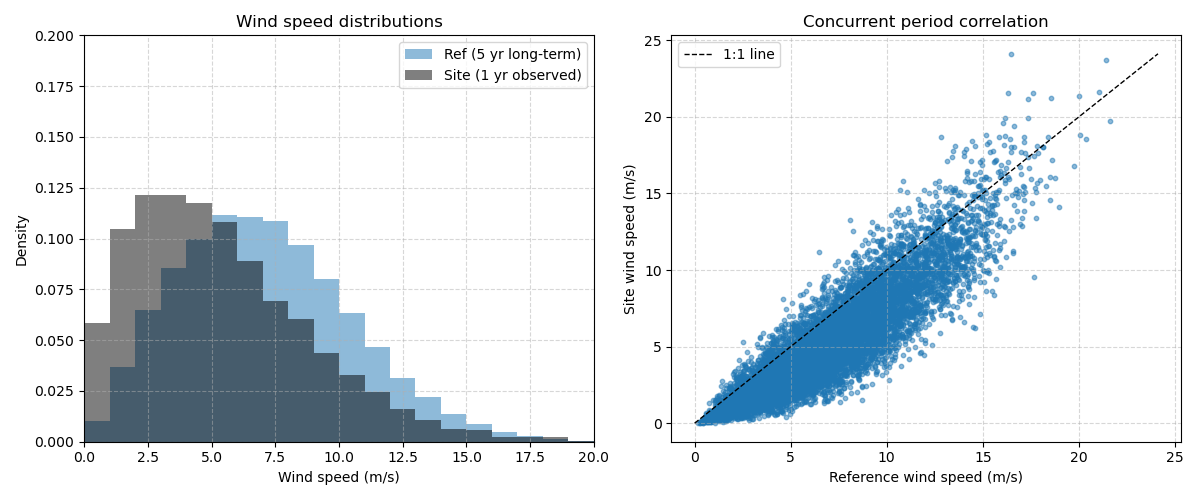
Wind Speed Distributions and Correlation#
bins_ws = np.linspace(0.0, 30.0, 31)

fig, (ax1, ax2) = plt.subplots(1, 2, figsize=(12, 5))
kw = dict(bins=bins_ws, density=True, alpha=0.5)
ax1.hist(
    ref_lt.wind_speed.values.flatten(), **kw, color="C0", label="Ref (5 yr long-term)"
)
ax1.hist(
    tgt_st.wind_speed.values.flatten(), **kw, color="k", label="Site (1 yr observed)"
)
ax1.set(
    xlabel="Wind speed (m/s)",
    ylabel="Density",
    title="Wind speed distributions",
    xlim=(0, 20),
    ylim=(0, 0.2),
)
ax1.legend()
ax1.grid(True, linestyle="--", alpha=0.5)

ws_max = max(ref_st.wind_speed.values.max(), tgt_st.wind_speed.values.max())
ax2.scatter(
    ref_st.wind_speed.values.flatten(),
    tgt_st.wind_speed.values.flatten(),
    alpha=0.5,
    color="C0",
    s=10,
)
ax2.plot([0, ws_max], [0, ws_max], "k--", linewidth=1, label="1:1 line")
ax2.set(
    xlabel="Reference wind speed (m/s)",
    ylabel="Site wind speed (m/s)",
    title="Concurrent period correlation",
)
ax2.legend()
ax2.grid(True, linestyle="--", alpha=0.5)
fig.tight_layout()
Fit MCP Models#
Both LinRegMCP (ordinary least squares) and
VarRatMCP (variance ratio regression) fit one
independent regression model per wind direction sector.
<windkit.ltc.mcp.VarRatMCP object at 0x70f5ffda5be0>
Predict Long-Term Wind Climate#
Apply the fitted models to the full 5-year reference to produce a long-term corrected time series at the site location.
predict() returns the deterministic
regression-line prediction (conditional mean).
predict_with_noise() adds Gaussian noise
sampled from the per-sector residual standard deviation, recovering
realistic variance in the predicted distribution.
pred_lt_linreg = linreg.predict(ref_lt)
pred_lt_linreg_noisy = linreg.predict_with_noise(ref_lt, seed=42)
pred_lt_varrat = varrat.predict(ref_lt)
Evaluate Model Performance#
Use calc_scores() to evaluate how well each model
reconstructs the site wind speeds over the concurrent period.
pred_st_linreg = linreg.predict(ref_st)
pred_st_linreg_noisy = linreg.predict_with_noise(ref_st, seed=42)
pred_st_varrat = varrat.predict(ref_st)

scores_baseline = calc_scores(tgt_st, ref_st, name="Baseline", period="Concurrent")
scores_linreg = calc_scores(tgt_st, pred_st_linreg, name="LinReg", period="Concurrent")
scores_linreg_noisy = calc_scores(
    tgt_st, pred_st_linreg_noisy, name="LinReg+noise", period="Concurrent"
)
scores_varrat = calc_scores(tgt_st, pred_st_varrat, name="VarRat", period="Concurrent")

print("BASELINE\n", scores_baseline.to_string(index=False), "\n")
print("LINREG (deterministic)\n", scores_linreg.to_string(index=False), "\n")
print("LINREG (with noise)\n", scores_linreg_noisy.to_string(index=False), "\n")
print("VARRAT\n", scores_varrat.to_string(index=False), "\n")
BASELINE
     Name     Period    Metric     Score
Baseline Concurrent       R^2  0.539602
Baseline Concurrent      RMSE  2.359109
Baseline Concurrent Mean bias -1.721997
Baseline Concurrent       EMD  1.731977

LINREG (deterministic)
   Name     Period    Metric         Score
LinReg Concurrent       R^2  7.959778e-01
LinReg Concurrent      RMSE  1.570435e+00
LinReg Concurrent Mean bias -1.872693e-07
LinReg Concurrent       EMD  3.831930e-01

LINREG (with noise)
         Name     Period    Metric     Score
LinReg+noise Concurrent       R^2  0.614580
LinReg+noise Concurrent      RMSE  2.158481
LinReg+noise Concurrent Mean bias -0.033881
LinReg+noise Concurrent       EMD  0.298426

VARRAT
   Name     Period    Metric         Score
VarRat Concurrent       R^2  7.842460e-01
VarRat Concurrent      RMSE  1.614956e+00
VarRat Concurrent Mean bias -2.404271e-07
VarRat Concurrent       EMD  3.279763e-01
Compare Long-Term Distributions#
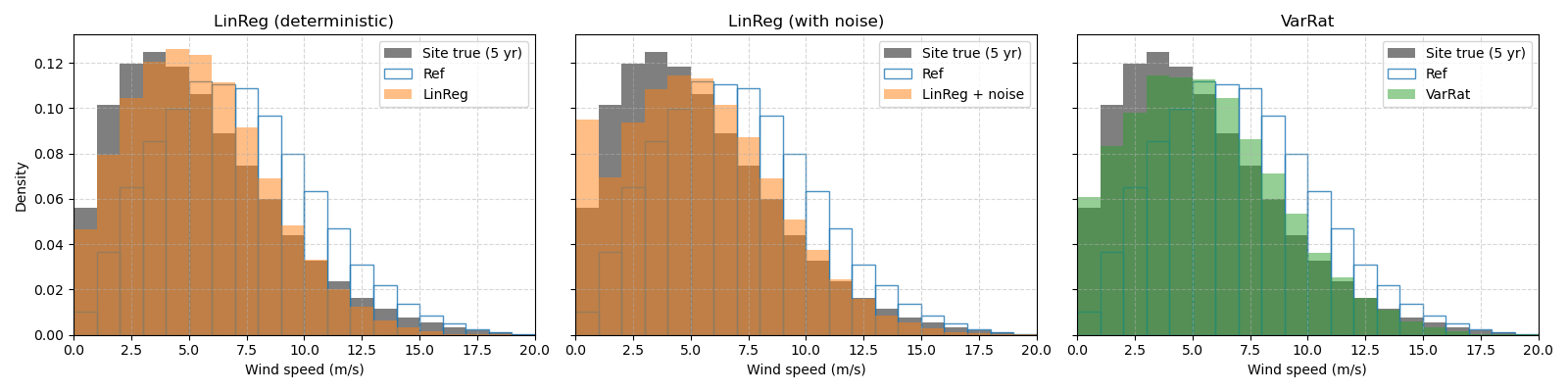
The deterministic LinReg prediction lies on the regression line and
compresses variance — the distribution is too narrow, clipping the
high-wind tail. Adding noise via
predict_with_noise() recovers the spread
by sampling from the per-sector residual distribution.
VarRatMCP recovers variance by construction
instead: its per-sector slope is set to std(y) / std(x), so the
predicted standard deviation matches the target directly without any
stochastic sampling.
ws_true = tgt_lt.wind_speed.values.flatten()
ws_ref = ref_lt.wind_speed.values.flatten()
ws_linreg = pred_lt_linreg.wind_speed.values.flatten()
ws_linreg_noisy = pred_lt_linreg_noisy.wind_speed.values.flatten()
ws_varrat = pred_lt_varrat.wind_speed.values.flatten()

kw_true = dict(
    bins=bins_ws, density=True, color="k", alpha=0.5, label="Site true (5 yr)"
)
fig, (ax1, ax2, ax3) = plt.subplots(1, 3, figsize=(16, 4), sharey=True)

ax1.hist(ws_true, **kw_true)
ax1.hist(
    ws_ref,
    bins=bins_ws,
    density=True,
    facecolor="none",
    edgecolor="C0",
    lw=1.0,
    alpha=0.8,
    label="Ref",
)
ax1.hist(ws_linreg, bins=bins_ws, density=True, color="C1", alpha=0.5, label="LinReg")
ax1.set(
    xlabel="Wind speed (m/s)",
    ylabel="Density",
    title="LinReg (deterministic)",
    xlim=(0, 20),
)
ax1.legend()
ax1.grid(True, linestyle="--", alpha=0.5)

ax2.hist(ws_true, **kw_true)
ax2.hist(
    ws_ref,
    bins=bins_ws,
    density=True,
    facecolor="none",
    edgecolor="C0",
    lw=1.0,
    alpha=0.8,
    label="Ref",
)
ax2.hist(
    ws_linreg_noisy,
    bins=bins_ws,
    density=True,
    color="C1",
    alpha=0.5,
    label="LinReg + noise",
)
ax2.set(xlabel="Wind speed (m/s)", title="LinReg (with noise)", xlim=(0, 20))
ax2.legend()
ax2.grid(True, linestyle="--", alpha=0.5)

ax3.hist(ws_true, **kw_true)
ax3.hist(
    ws_ref,
    bins=bins_ws,
    density=True,
    facecolor="none",
    edgecolor="C0",
    lw=1.0,
    alpha=0.8,
    label="Ref",
)
ax3.hist(ws_varrat, bins=bins_ws, density=True, color="C2", alpha=0.5, label="VarRat")
ax3.set(xlabel="Wind speed (m/s)", title="VarRat", xlim=(0, 20))
ax3.legend()
ax3.grid(True, linestyle="--", alpha=0.5)

fig.tight_layout()
Variance Recovery#
The standard deviation of the predicted wind speeds shows how
deterministic LinReg compresses variance, while predict_with_noise
and VarRat both recover the spread.
Site true std:           3.447 m/s
LinReg (deterministic):  3.040 m/s
LinReg (with noise):     3.340 m/s
VarRat:                  3.412 m/s
Total running time of the script: (0 minutes 1.930 seconds)